Understanding water engineering.



A tapping saddle fitted around an exposed water main.
Photo: Cascade Water Services · Original Photograph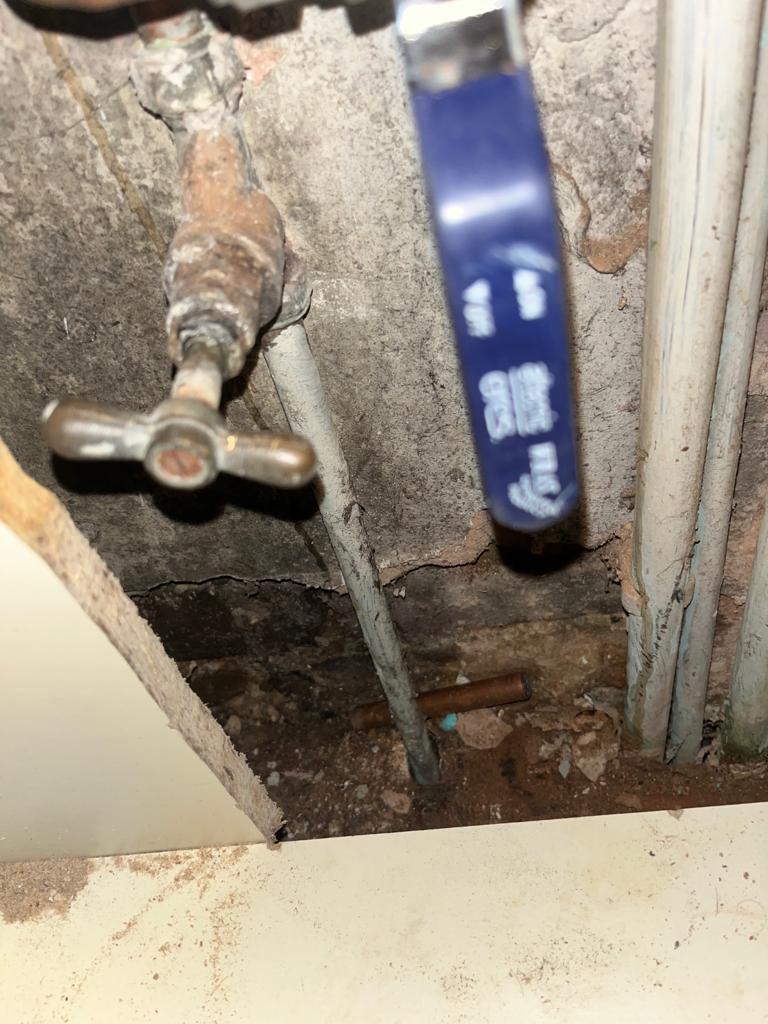
An existing stop valve and pipework within a service space.
Photo: CW Pipewise · Original PhotographFrom a leaking domestic supply pipe to a larger commercial water main, understand the work, the methods and what to ask your contractor.
Water Mains and Supply Pipes
What is a water main?
A public water main distributes water through the water company’s network, supplying streets or wider areas. It is maintained by the water company. A large pipe within a private commercial site may also be called a “water main”, but that description alone does not make it a public asset: ownership and adoption status must be checked.
What is a water supply pipe, and how does it differ from a communication pipe?
The service pipe links premises to the public main. It normally comprises the water company’s communication pipe and the privately maintained supply pipe. The communication pipe usually ends at the street boundary; the supply pipe continues towards the building’s internal stop tap. The exact responsibility point can differ where the main or pipe route is unusual.
What is the difference between an individual and a shared supply pipe?
An individual supply pipe serves one property. A shared supply has a common section serving two or more properties before branching towards each building. A property can therefore have both a shared section and a branch serving only that property.
When neighbours draw water at the same time, a shared supply may limit available flow. Separate supplies can be an option, subject to the water company’s connection process and the necessary access agreements.
Who is responsible for a leak on a shared supply?
Responsibility generally follows which properties the affected section serves. Owners may share responsibility for a common section, while a branch serving one property is normally that owner’s responsibility. A pipe crossing your land is not, by itself, proof that the whole pipe is yours.
Confirm the route, leak location, properties served and ownership arrangements before agreeing repair costs. This is a UK directory: check the applicable arrangements with your local water company rather than assuming every boundary or shared supply is the same.
Our work
What does a water engineer do?
Water engineers investigate, repair, replace and install water mains and supply pipes. Their work combines pipework knowledge with water hygiene, locating buried services, excavation, trenchless installation and reinstatement. The directory helps you find companies offering the specific service your project needs.
How is this different from general plumbing?
A general plumbing qualification alone does not demonstrate competence in underground mains, specialist jointing or trenchless installation. Some plumbers also hold these skills; the important question is whether the contractor can demonstrate relevant training, approval and experience for your job. Water engineering is the specialist discipline also used by water companies to maintain and install their networks.
What are typical examples of work?
- Replacing an ageing lead supply pipe between the boundary and a house.
- Locating and repairing a leak beneath a driveway or garden.
- Renewing a shared supply or installing separate supplies, subject to the required agreements.
- Installing a commercial site's water main, valves and connections.
- Installing a longer pipe route using directional drilling where the site is suitable.
- Self-lay work delivered by a contractor with the appropriate scope and water company acceptance.
These are examples of job types, not claims that every listed company undertakes every activity. Self lay is currently listed only for Cascade.
Should a leaking pipe be repaired or replaced?
A local repair may be appropriate for an isolated defect in otherwise serviceable pipework. Replacement may be more suitable where the pipe is deteriorated, repeatedly leaking, inaccessible or unsuitable for the required supply. The engineer should explain the findings, options, disruption and quoted scope before you decide.
Trenchless installation
What does “trenchless” mean?
Trenchless methods install pipes underground without excavating a continuous trench along the whole route. Access pits, connection excavations and some reinstatement are usually still needed. Suitability depends on the ground, buried services, route, access and the pipe being installed.
What is impact moling?
A pneumatic soil-displacement tool travels between prepared access pits, creating space for a new pipe or duct. Conventional impact moling is not steerable during a run, so alignment and route assessment matter. It is commonly considered for shorter supply pipe routes beneath gardens, paths and driveways.
How does horizontal directional drilling differ?
Horizontal directional drilling uses a guided drill to form a pilot bore. The bore can then be enlarged as required and the pipe drawn through. It can suit longer routes and selected crossings; achievable distance, depth and curvature depend on the equipment, pipe, ground and site design.
Will my garden or driveway need digging up?
Trenchless installation can reduce excavation, but it does not mean no digging. Ask the contractor to identify proposed pits and connection points, explain how existing services will be checked and set out the reinstatement included in the price. An open trench may be the appropriate option on some routes.
Finding a leak
How does acoustic leak detection work?
Escaping pressurised water can create sound that travels through the pipe and surrounding ground. An engineer uses listening equipment at accessible fittings and a ground microphone to compare sounds along the suspected route. Pipe material, pressure, depth and background noise influence the result.
What is leak noise correlation?
Sensors listen at two points on a pipe. A correlator compares the leak noise arriving at each sensor to estimate its position using information about the pipe and distance between sensors. Reliable pipe information and suitable access help the engineer interpret the result.
How does tracer-gas leak detection work?
A trained engineer introduces a purpose-made tracer-gas mixture into an appropriately prepared pipe section. A sensitive detector searches for gas escaping from the leak and reaching the surface. A commonly used mixture is 95% nitrogen and 5% hydrogen.
It can help when a leak produces too little sound for acoustic detection. Preparation, isolation and any interruption to the water supply should be explained before the investigation.
Which leak detection method is best?
The method follows the site. An engineer may combine meter observations, isolation checks, pipe tracing, acoustic listening, correlation and tracer gas. No single technique guarantees a result in every situation. Ask what the investigation includes, what uncertainty remains and whether excavation or repair is priced separately.
Self Lay Explained
What does self lay mean?
Self lay is an arrangement in which an independent self-lay provider installs agreed new water mains and service connections, commonly for a development, for adoption by the water company. It does not simply mean a homeowner digging a trench or a contractor replacing a private supply pipe.
The provider carries out the work permitted under the water company’s arrangements. Some activities remain reserved to the water company. Scope and procedures must be confirmed for the relevant UK water company.
What does adoption mean, and what happens before a self-laid main is connected?
Adoption is the formal transfer of agreed assets into the water company’s network ownership and maintenance arrangements. Laying the pipe alone does not complete that process.
The project normally needs an accepted design and adoption agreement, followed by construction, pressure testing, disinfection, water-quality checks and an authorised connection. The water company specifies the evidence, inspections and records required. The agreement defines which assets it adopts and any remaining defect obligations.
Example of the construction and adoption process: Thames Water
Can every water engineer carry out self-lay work?
No. Check the provider’s accreditation and permitted scope, alongside the water company’s acceptance of the project. For example, Thames Water requires self-lay providers to hold Water Industry Registration Scheme (WIRS) accreditation. WaterSafe registration or WIAPS approval alone does not establish self-lay capability.
In this directory, Self Lay is currently listed only for Cascade Water Services. Confirm its current accreditation, project scope and water company acceptance directly before appointment.
Planning your work
Can every company work on larger commercial mains?
No. Domestic supply pipe experience or a particular approval does not automatically establish competence for every pipe size, material or installation method. Ask for comparable projects, the relevant approvals and confirmation that the proposed team and equipment suit your project.
What training and credentials should I check?
Our standard requires relevant water-company or equivalent network experience within the team, at least £10m public liability cover, EUSR Water Hygiene, SHEA Water, Service Avoidance training, and current relevant approved-contractor scheme registration and certification scope for the relevant work. Lucking Utility Services is Verified & Approved by the directory owner. Other listed companies are awaiting assessment. Check each company profile for its evidence, approval basis and service scope. NDWE approval is separate from current water-industry scheme registration.
Will I receive a WIAPS certificate?
A currently approved WIAPS contractor can issue certificates of compliance for work within its approved scope, subject to scheme requirements. WaterSafe registration is not itself a training qualification or proof of WIAPS membership. Before appointing a company, confirm its current approval and the certificate it will provide for your particular work.
What should I provide before a survey?
Share the property address, symptoms or water company notice, any meter readings already recorded, photographs, known pipe routes and information about access. For larger sites, supply available utility drawings and proposed connection points. Tell the engineer about shared supplies and any surfaces or planting that need particular care.
Explore Water Engineering Services
Find the right expertise
for your water pipework.
A true specialist trade between plumbing and groundworks.
Customer trust built on experience, training and accountability.